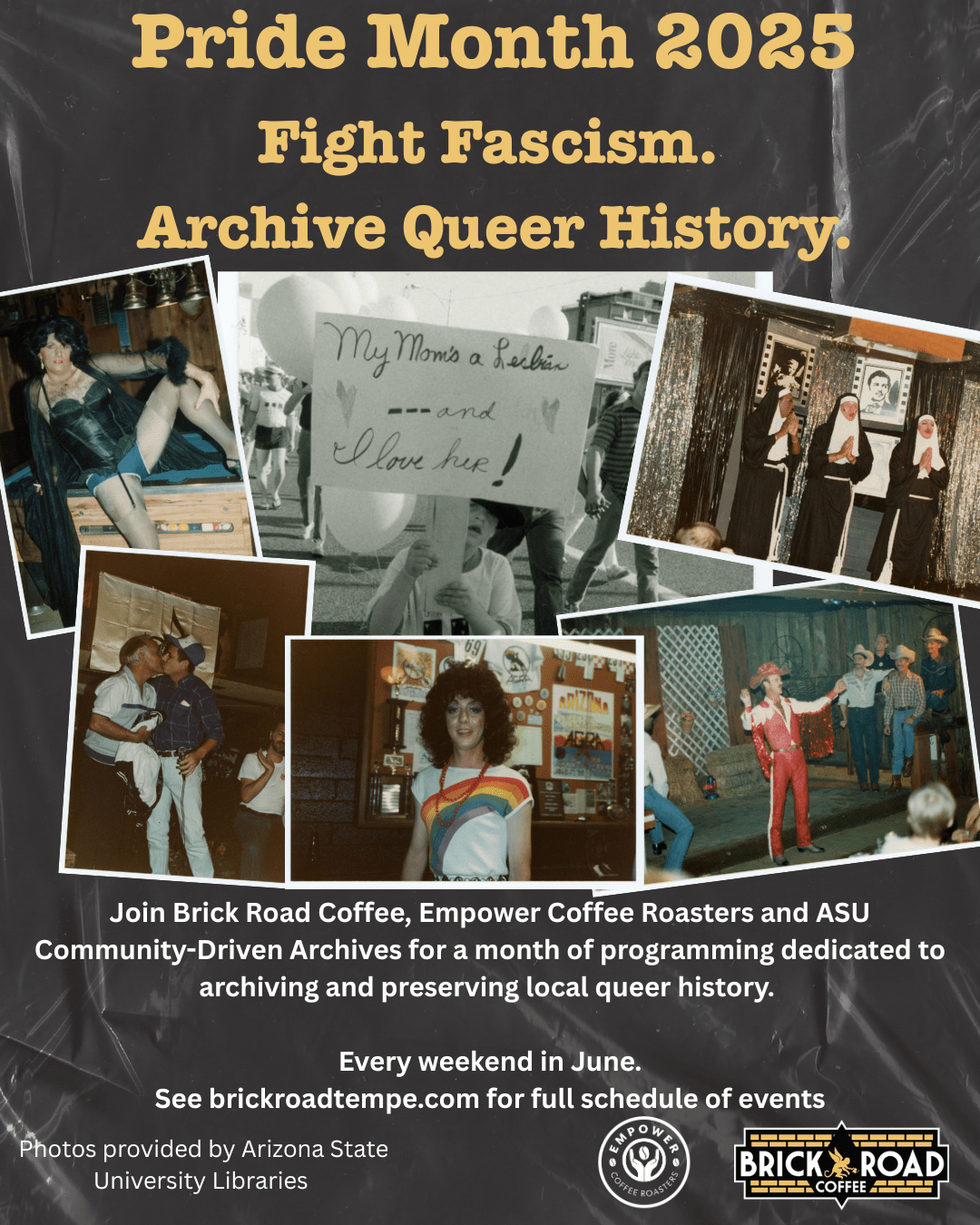
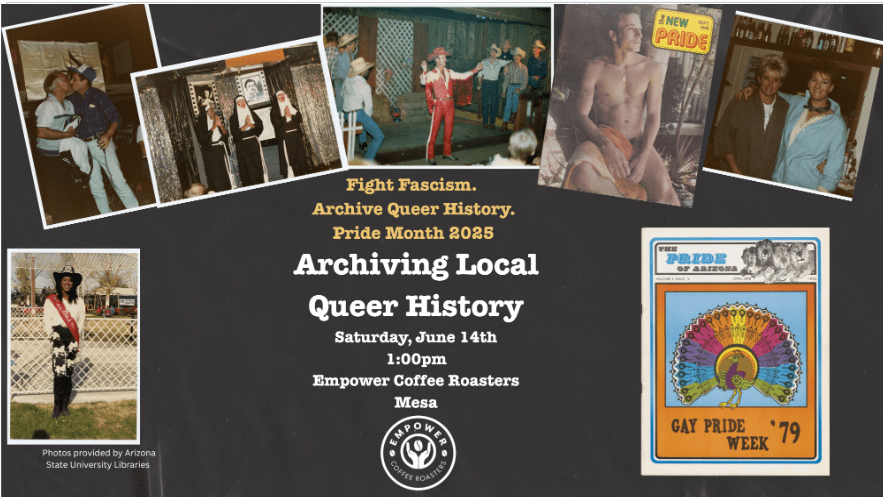
Image courtesy of David Boyles and ASU Libraries.
In June of 2025, I was able to be part of Brick Road Coffee’s Pride Events. This year, the theme was extremely fittingly: “Fight Fascism. Archive Queer History.”
Under fascist and authoritarian regimes, queer history is among the first to be obliterated. That’s why, especially now, it’s so important for us to actively save our personal and community histories.
On June 1st, Empower Coffee and Professor David Boyles screened Screaming Queens: The Riot at Compton’s Cafeteria, in which archivist Susan Stryker recounts how she uncovered the history of “the first known act of collective, violent resistance to the social oppression of queer people int he United States,” a riot in 1966 in San Francisco’s Tenderloin district. Stryker researched, found, and interviewed the individuals, most of them trans women, to reveal their stories and ensure they live on.
On June 7th, the film P.S. Burn This Letter Please was screened. A box of letters, found in a storage locker in 2014, held invaluable insight into the lives of the queer scene in New York City in the 1950s through the 1960s, with a focus on gender non-conformists, such as drag queens and female impersonators. In this documentary, as well, many of the letter-writers were found and interviewed, and their stories added to the queer history of the United States. For more on the film, see: https://www.psburnthisletterplease.com/
You can watch both of these films for free:
- Screaming Queens: The Riot at Compton’s Cafeteria, YouTube
- P.S. Burn This Letter Please, Tubi
- There is also a book, available here!
On June 14th, I was fortunate enough to be one of three amazing queer researchers and activists to present our work in local LGBTQ+ history, specifically, in the B.J. Bud Archives.
Thanks to Nancy Godoy and her team at the ASU Library, the Community-Driven Archives Initiative, or CDA, was able to make Arizona’s largest collection of queer material available to researchers, like Mellissa Linton and her students, and myself.
Thanks to my partner, Cassie Ebersole, we were able to record my presentation:
These Pride events not only served as public education, community-building, and celebration, but reminded us all of why Pride is so important. Pride is not for us to convince people that we deserve to exist, but it is for us to exist, and to love, loudly and unapologetically. Pride reminds us to fight for a world in which we all can exist and love loudly, unapologetically, and safely, and honor those before us who have paved the way to the present.
If you have stories, research, or media recommendations (books, movies, etc.) to share, please comment or reach out to me. All of our stories are worth knowing, and all of our stories show that we are not alone.
 How Did We Get Here?