Since Spring of 2025, I’ve been actively researching the history of the LGBTQ+ community in Arizona, but particularly in the East Valley. Growing up in the East Valley, I didn’t feel as though queerness was at all accessible to me. Queer people were a thing of the big cities of the coasts, right? At least, that’s what was the line I heard outside of my home. I remember sleepovers in junior high where I found myself defending my “out” family members. As I grew up, I realized that queerness is, and always has been, everywhere – you just have to look for it.
Pride in Tempe: Kiwanis Park and Tempe Diablo Stadium
I started in the BJ Bud Memorial Archives, part of ASU’s Community-Driven Archives, and one of the most amazing things I found was the recent history of huge Pride events in Tempe. The 1990s was a time of incredible change for Arizona’s largest Pride organization. Since 1981, Pride in Arizona was held in various places in and around Downtown Phoenix, starting with marches on the State Capitol. Facing continuous backlash, however, in 1991, the Phoenix Lesbian and Gay Pride Committee looked elsewhere, and chose Kiwanis Park in Tempe. That year, the planning committee were ready for about 2,000 attendees, and were blown away with 5,600.
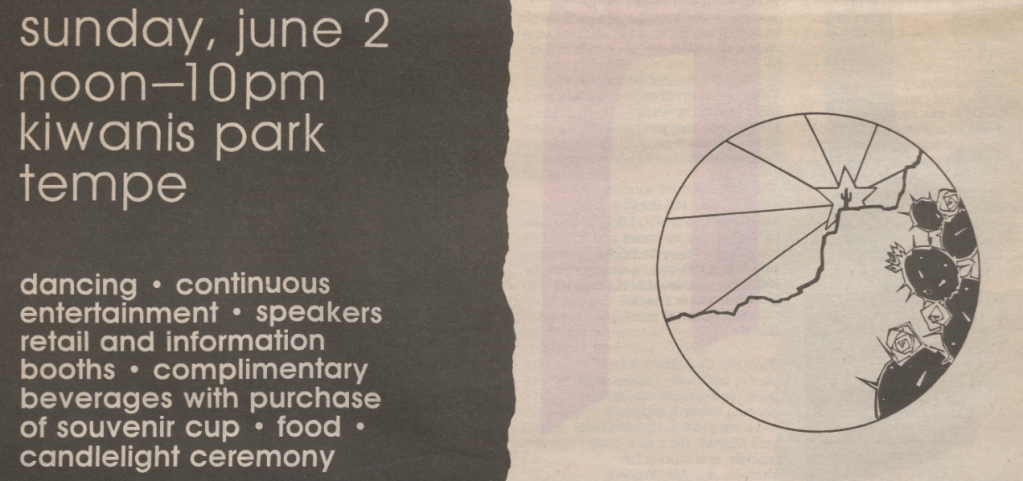
Phoenix Resource, Vol. 7, Number 11. May 24, 1991. Greater Arizona Collection: Valley of the Sun Gay and Lesbian Center (Phoenix, Ariz.). Bj Bud Memorial Archives 1966-2015. Arizona State University, Tempe, AZ. 4 June, 2026.
According to PLGPC President Beth Verity, Tempe Parks officials suggested they try the soccer fields at Tempe Diablo Stadium to accommodate larger crowds. From 1992 to 1997, “Phoenix” Pride was celebrated there, prompting the PLGPC to change their name to “Arizona Central Pride” in 1996.

Phoenix Lesbian and Gay Pride Committee, Inc. 1993 Pride Pamphlet. June 6, 1993. Box 11, Folder 19. Bj Bud Memorial Archives 1966-2015. Arizona State University, Tempe, AZ. December 18, 2025.
Women’s Central News and the Phoenix Zoo
The LGBTQ+ periodicals and Pride materials from the 1990s show a wide array of different groups, events, and spatial connections. As a lesbian, one of my favorite finds was this clip from Women’s Central News, Central Arizona’s only lesbian/femme periodical based out of Tempe in the 1990s.

Women’s Central News: Arizona’s Lesbian Newspaper, Vol. 20, Number 11. January 1994. Greater Arizona Collection: Valley of the Sun Gay and Lesbian Center (Phoenix, Ariz.). Bj Bud Memorial Archives 1966-2015. Arizona State University, Tempe, AZ. 4 June, 2026.
The “Lesbian Breakfast Club” was a group of people who identified as lesbians who met every Sunday at 10AM at a different breakfast spot, and the red brick representing their donation to the Phoenix Zoo’s spectacled bear exhibit is still on the entrance bridge, now in row 154. It’s not the only one – on a visit to the Zoo to see this brick for myself, the wonderful staff in the visitor’s center also found a brick titled, “Lesbian and Gay Academic Club,” which is another red brick in row 210. Just the regularity of bricks with the words “lesbian” and “gay,” where hundreds of people walk over them each day, feels remarkable in a world in which “don’t say gay” laws and policies have been just as commonplace.
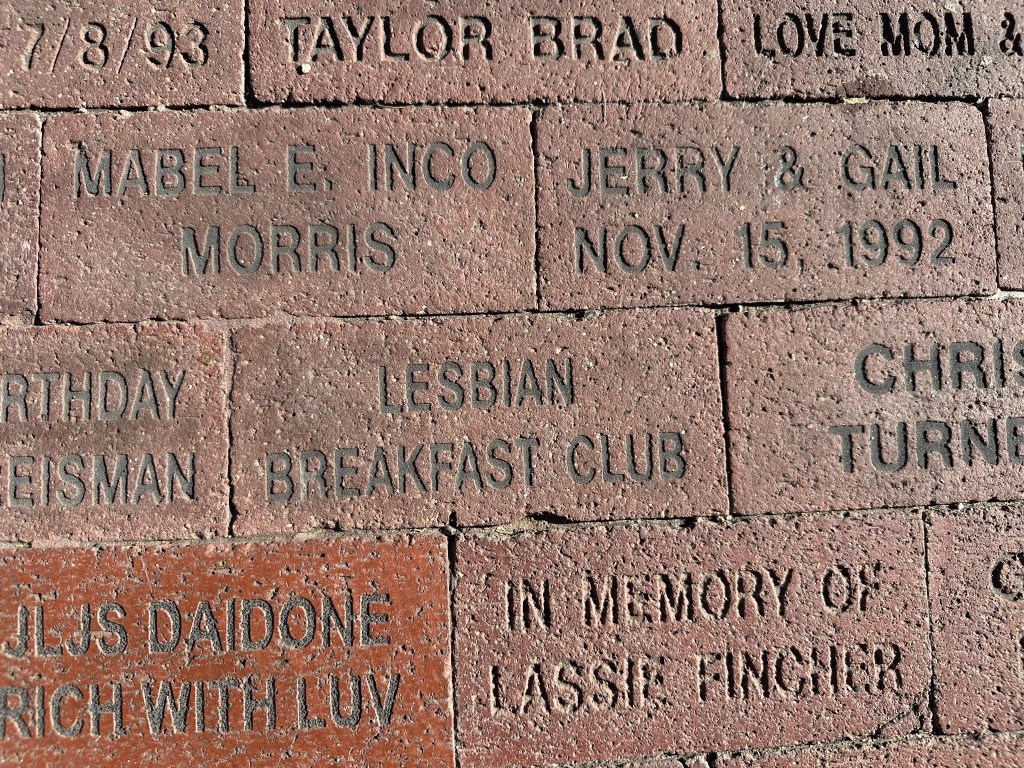
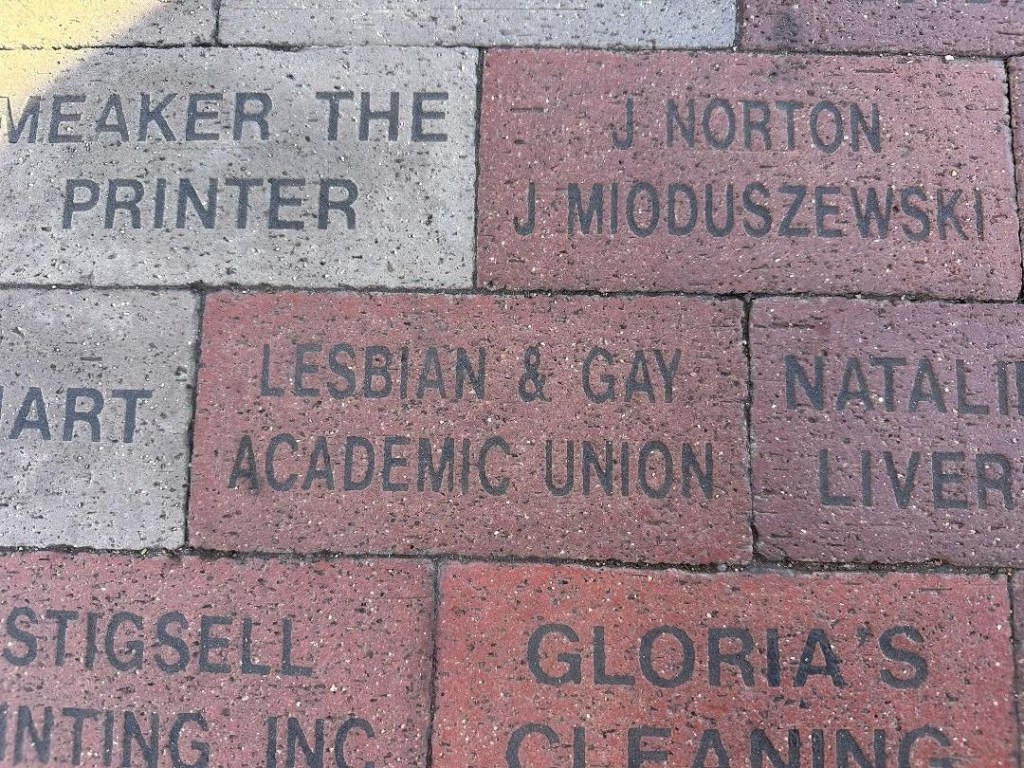
Photos taken by me in December 2025 at the Phoenix Zoo.
Mill Ave and Changing Hands
Mill Ave has been the center of Tempe since it was made a town by settlers, and gets its name from The Hayden Flour Mill, established by businessman Charles T. Hayden. As the first was destroyed in a fire, the concrete mill is still there, and is now a platform for light-projection protest and a subject of debate for the city, its owners, and the public.
But ten years before the Mill closed in 1981, Tempe’s population was booming, and the city’s LGBTQ+ population grew with it. Changing Hands Bookstore was opened by Gayle Shanks and Tom Broderson in 1974 in a 500-square foot space in downtown Tempe, until they upgraded their space in 1978 to a spot on Mill Avenue. Until 1998, they were a fixture for the community, and were vocal about their support for LGBTQ+ rights, regularly sponsoring the annual Pride events.

Phoenix Lesbian and Gay Pride Committee, Inc. 1992 Pride Pamphlet. June 7, 1992. Box 11, Folder 19. Bj Bud Memorial Archives 1966-2015. Arizona State University, Tempe, AZ. December 18, 2025.
In 1998, as Arizona Central Pride relocated to Phoenix, Changing Hands had to move, too. Mill Ave’s success had drawn in corporations with deep pockets, and Gayle Shanks explained, landlords raised their rates accordingly, pushing out local stores like Changing Hands. Today, the bookstore has locations in Phoenix and in Tempe, and continues to be an affirming third space for the East Valley and beyond.
Recently, the City of Tempe has been trying to revive Mill Ave’s community roots and pull its reputation away slightly from ASU’s primary party spot. In 2024, Downtown Tempe hosted a “Pride Party” in the Centerpoint Plaza, a free event to celebrate Pride month with music, food, and different activities.
Rocket Space Gallery at Danelle Plaza
Danelle Plaza, on the corner of Mill and Southern, has been a community hub for Tempe residents since the 1960s. Soon after buildings went up, cultural hubs began moving in, including numerous bars known for their live music. In 1972, local Peter Hu bought one of these, Frank’s Yucca Lounge, and renamed it “Yucca Tap Room,” keeping the local music and successful vibe. Today, community members continue to fight for the Plaza’s local character and use as independent third spaces through the Danelle Project, @thedanelleproject.
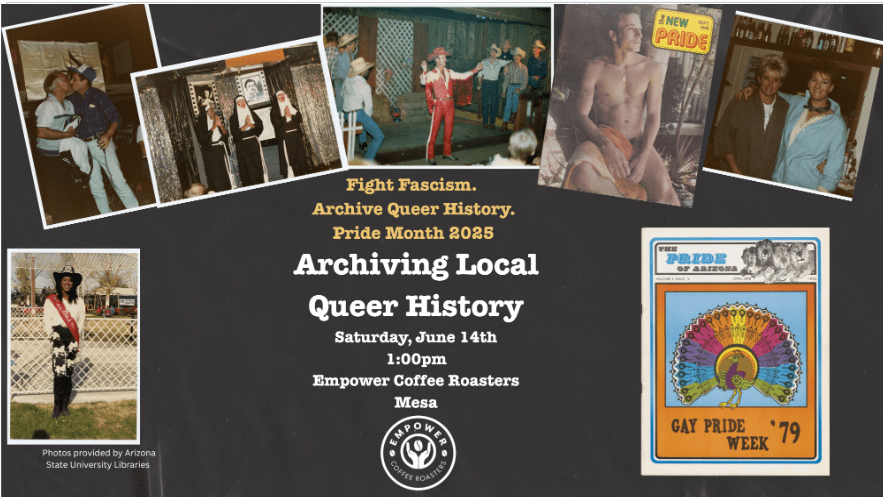
In 2025, a new space opened: Rocket Space Gallery. The first show they put on in the space was Tempe Queer Takeover, and I had the honor of contributing a piece. The Tempe Art and Music Coalition, @tempeartandmusic, which runs the Gallery, is an organization committed to keeping the community art scene flourishing and accessible. The space is regularly host to local artists, bands, and various workshops promoting community and justice.
Brick Road Coffee and Community
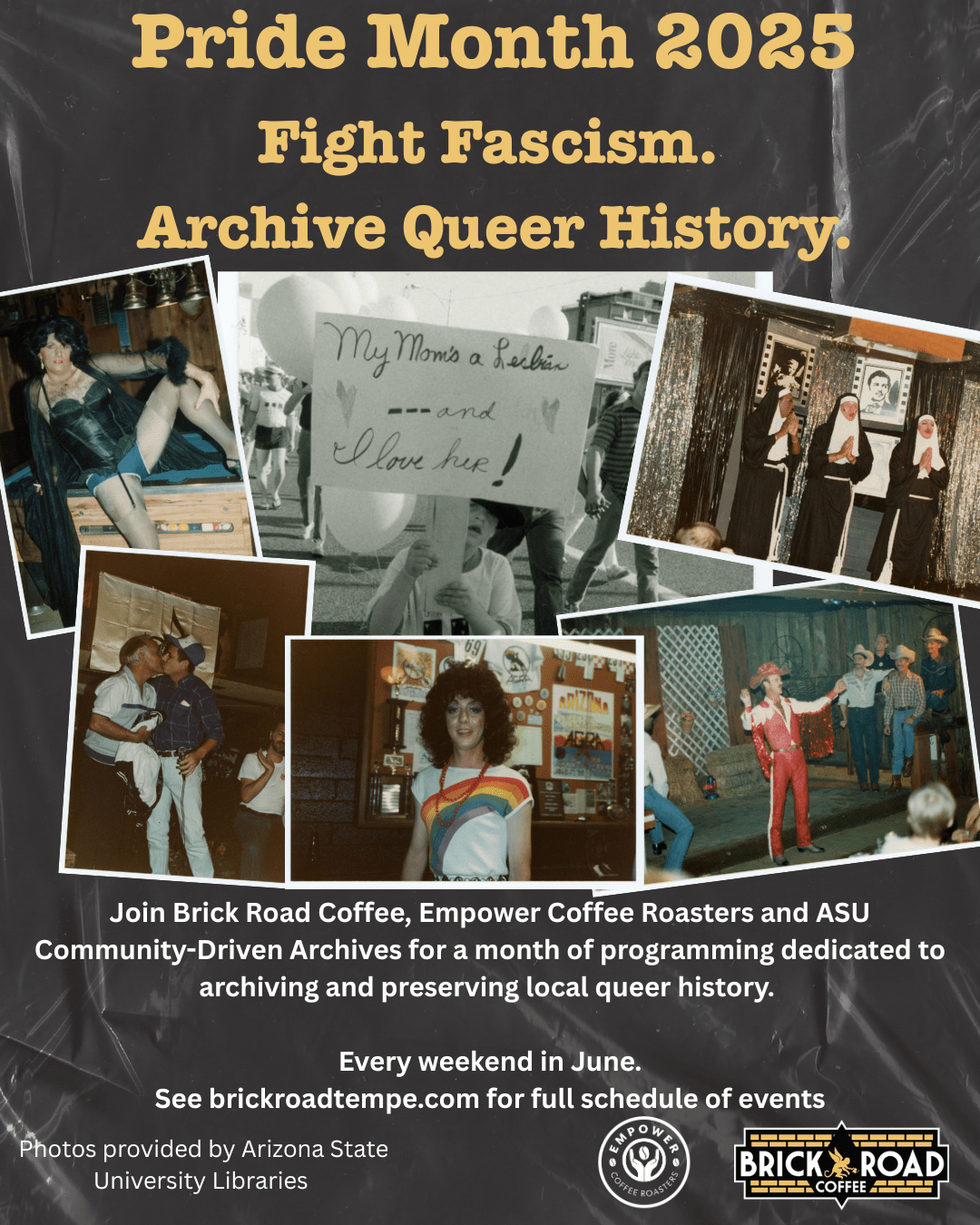
Brick Road Coffee was opened in 2021 by owners Gabe and Jesse, and has been serving the LGBTQ+ community since. Their mission is to use coffee to connect, uplift, and educate, and hosts dozens of regular meetups for local LGBTQ+ groups as well as big events such as their annual October Trunk or Treat and Queer Art Market. Check out @brickroadcommunity on Instagram for their Pride 2026 events – I’ll be at most of them!
Public History, Art, and Activism
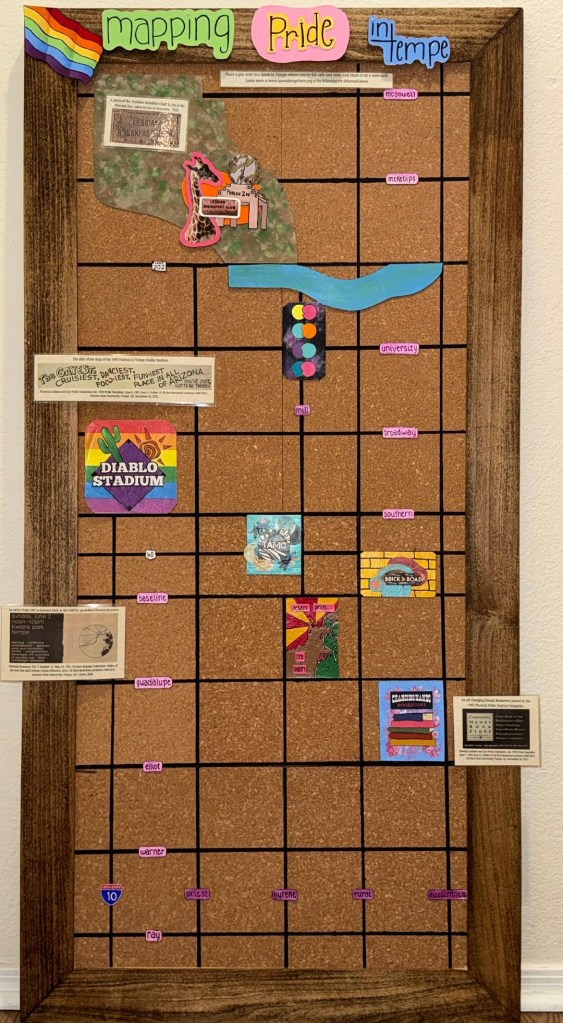
All of these spaces are marked on the “Mapping Pride in Tempe” interactive art project. Currently at Brick Road Tempe, I invite you to stop in and place a pin by one of these locations, or another in and around Tempe, in which you have a memory of safety and acceptance, and write a short note about it. This is an ongoing project, pulling together history and art as vehicles for positive change, and I’d love nothing more than for you all to interact with it and me.
If you or anyone you know has stories to share of LGBTQ+ community in the East Valley (or corrections to make!), please reach out to me via email at hboese@cox.net.
For further learning, check out these links!
Salt River Stories: “Mill Avenue Bridge” by Shannon Maki
PRISM: Bj Bud Memorial Archives
KJZZ: “How Changing Hands Bookstore Changed Over the Years” by Christina Estes
The Danelle Project: “Live Music Legacy”
 How Did We Get Here?