
Be yourself; Everyone else is already taken.
— Oscar Wilde.
This is the first post on my new blog, where public history takes center stage as I combine historical context and social activism. History and you can change the world.
Be yourself; Everyone else is already taken.
— Oscar Wilde.
This is the first post on my new blog, where public history takes center stage as I combine historical context and social activism. History and you can change the world.
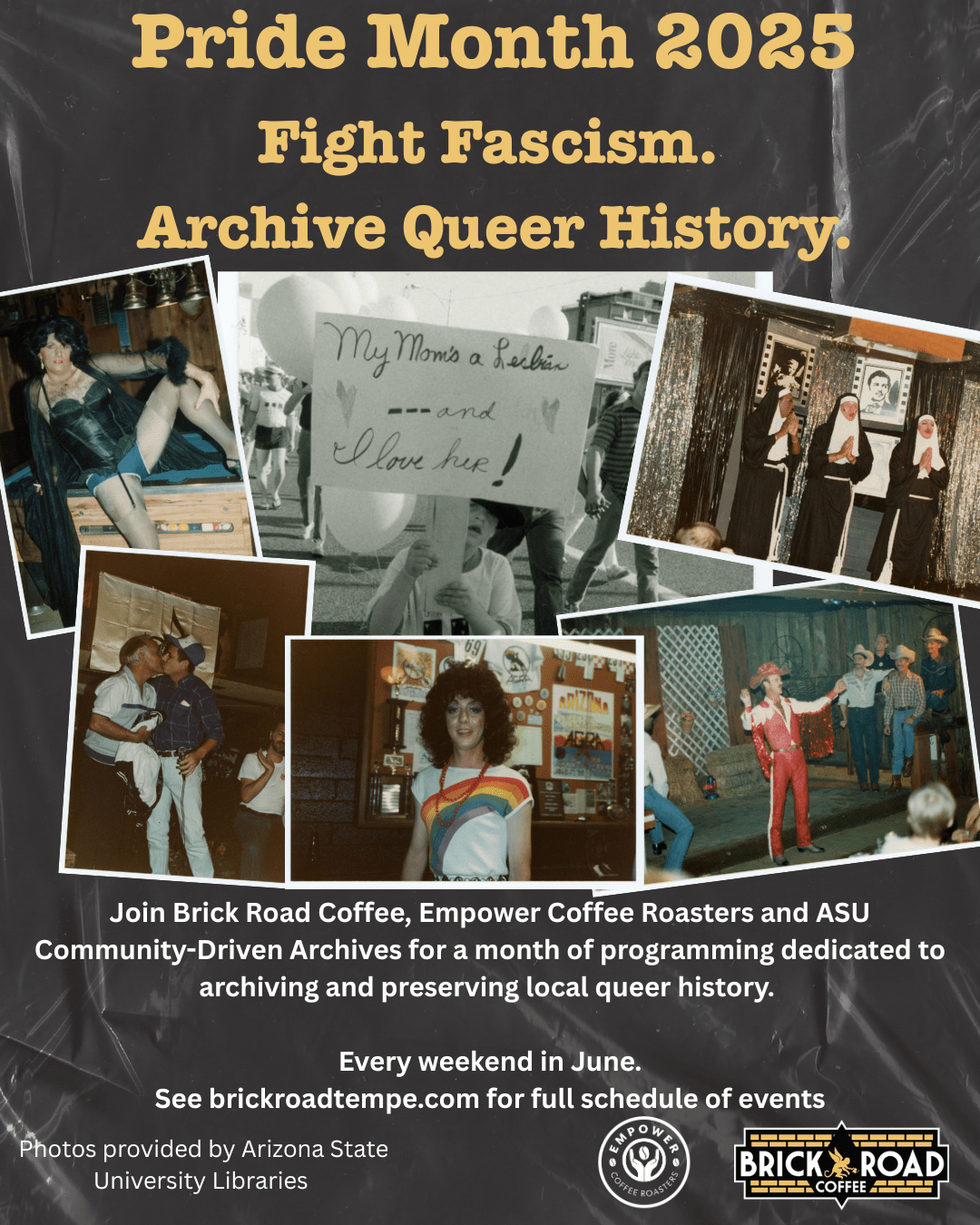
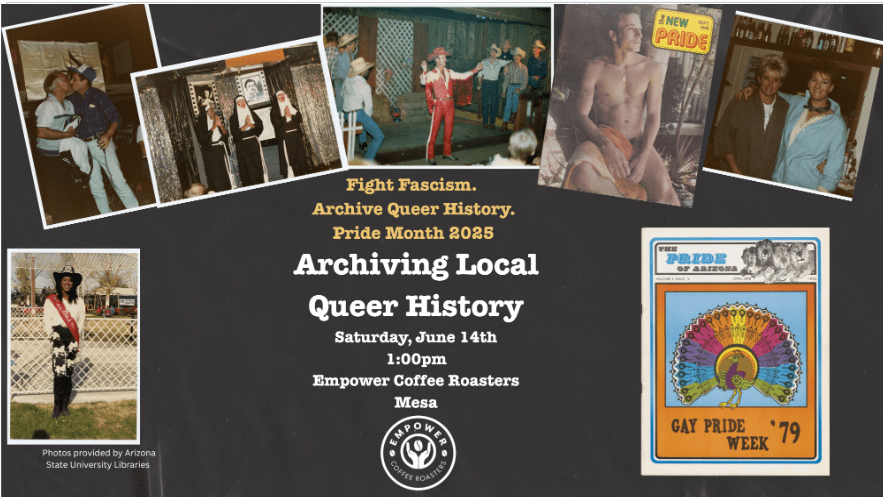
Image courtesy of David Boyles and ASU Libraries.
In June of 2025, I was able to be part of Brick Road Coffee’s Pride Events. This year, the theme was extremely fittingly: “Fight Fascism. Archive Queer History.”
Under fascist and authoritarian regimes, queer history is among the first to be obliterated. That’s why, especially now, it’s so important for us to actively save our personal and community histories.
On June 1st, Empower Coffee and Professor David Boyles screened Screaming Queens: The Riot at Compton’s Cafeteria, in which archivist Susan Stryker recounts how she uncovered the history of “the first known act of collective, violent resistance to the social oppression of queer people int he United States,” a riot in 1966 in San Francisco’s Tenderloin district. Stryker researched, found, and interviewed the individuals, most of them trans women, to reveal their stories and ensure they live on.
On June 7th, the film P.S. Burn This Letter Please was screened. A box of letters, found in a storage locker in 2014, held invaluable insight into the lives of the queer scene in New York City in the 1950s through the 1960s, with a focus on gender non-conformists, such as drag queens and female impersonators. In this documentary, as well, many of the letter-writers were found and interviewed, and their stories added to the queer history of the United States. For more on the film, see: https://www.psburnthisletterplease.com/
You can watch both of these films for free:
On June 14th, I was fortunate enough to be one of three amazing queer researchers and activists to present our work in local LGBTQ+ history, specifically, in the B.J. Bud Archives.
Thanks to Nancy Godoy and her team at the ASU Library, the Community-Driven Archives Initiative, or CDA, was able to make Arizona’s largest collection of queer material available to researchers, like Mellissa Linton and her students, and myself.
Thanks to my partner, Cassie Ebersole, we were able to record my presentation:
These Pride events not only served as public education, community-building, and celebration, but reminded us all of why Pride is so important. Pride is not for us to convince people that we deserve to exist, but it is for us to exist, and to love, loudly and unapologetically. Pride reminds us to fight for a world in which we all can exist and love loudly, unapologetically, and safely, and honor those before us who have paved the way to the present.
If you have stories, research, or media recommendations (books, movies, etc.) to share, please comment or reach out to me. All of our stories are worth knowing, and all of our stories show that we are not alone.
To see my most recent work, completed for my Master of Arts in History with distinction at Arizona State University, check out my portfolio, linked here.
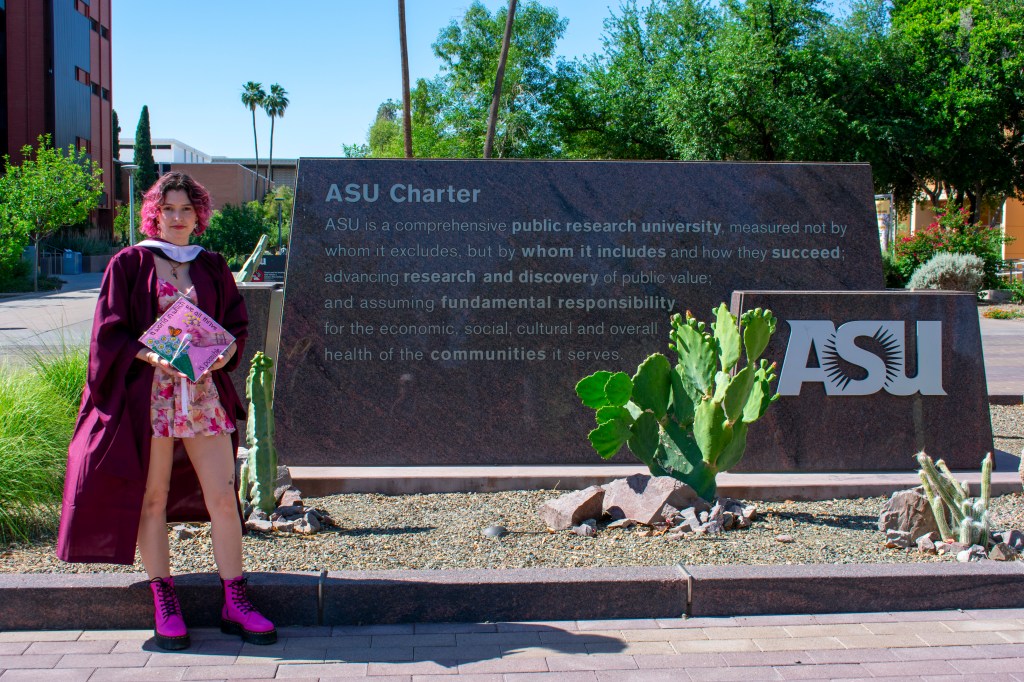
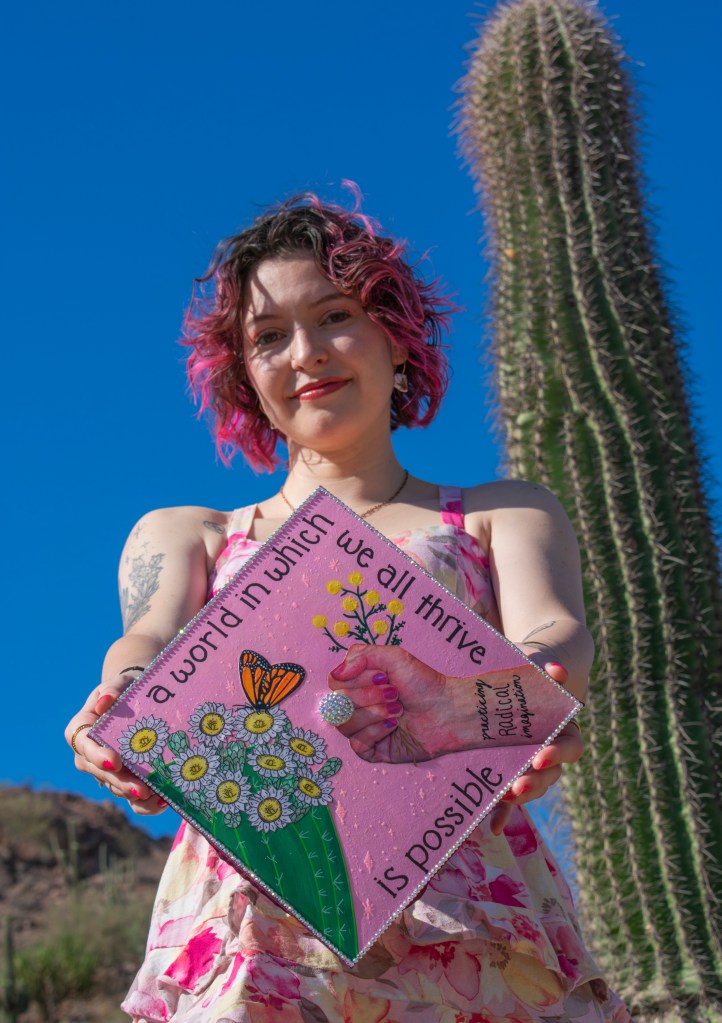
My M.A. graduation cap is a multimedia art project that my partner Cassie and I created to show not only what I learned in the program, but my aspirations moving forward.
The inspiration for my cap came largely from reading Andrea J. Ritchie’s book, Practicing New Worlds: Abolition and Emergent Strategies. In the following sections, key points from her book help explain the far-reaching goals of this art project.
Abolition
“Abolition” references the abolition of the Prison and Military Industrial Complexes. To be an abolitionist is to commit to “the practice of a world without surveillance, police, prisons, jails, or cages of any kind.” However, it is not so simple as “abolishing” these systems. It is about creating a world in which these systems “are no longer possible,” because the conditions, logics, and values “that produce and justify their existence no longer exist.” It requires that we create a world not only in which there are no prisons, but one in which they are unnecessary.
Emergent Strategies
Emergent strategies are, according to Ritchie and her colleague and author of Emergent Strategy adrienne maree brown, a “set of ideas about how to create, shift, and change complex systems – including human society – through relatively simple interactions.” These ideas include starting small, allowing for and learning from uncertainty, multiple perspectives and possibilities, experimentation, adaptation, iteration (or repeating processes), and decentralization.
When we, as people, focus on personal connections and relationships, building community, acting and reacting with intention, and cooperate with shared goals of sustainability, possibilities for change and action that we can take emerge. Allowing for such possibilities to emerge in these ways are emergent strategies.
Complexity Science
Complexity science refers to “scientific principles governing the operation of complex systems in nature and society” – in other words, how organisms act individually, repeated in groups, societies, and nations. For example, slime mold begins and lives as single cell organisms, acting independently when there is plentiful food. When food supply decreases, the individual cells coalesce, or combine, becoming a single organism that searches for food.
Together, abolitionist principles, emergent strategies, and complexity science show us how we can use small-scale change to enact the same radical change on larger scales. By learning from history and the natural world, we can use what we know to imagine, and create, new worlds.
These principles deny that we have to wait for something outside of us to prompt our action, for “it is in our power to shift the world within and around us.”
Imagining a New World in the Sonoran Desert
In this project, Cassie took and edited a picture of my hand, which is pulling up stinknet that I painted. If you come across stinknet, however, it is important to remove with gloves and a mask (see this link for more). In the place of the uprooted stinknet is a saguaro with blooms, and a monarch pollinating one of the blooms.
Stinknet is an invasive species in the Sonoran Desert that grow quickly and densely, displacing and crowding out native vegetation. Stinknet is also noxious, and can cause allergic reactions when it blooms, both to the skin and respiratory system. When they dry out, they are incredibly flammable, and the smoke is caustic, or destroys organic tissue.
The saguaro is a cactus only found in low elevations of the Sonoran desert, which covers most of southern Arizona, part of lower eastern California, and down through the Baja peninsula and western Sonora. These slow-growing, resilient giants are considered adults at 125 years, and are mostly water. Saguaros bloom through late April through early June, and flowers open at night and close the next afternoon. To become fruit, each flower must be pollinated within this short time period. To save water and reduce heat, they respirate at night, when temperatures drop below 90 degrees. The greatest threat to saguaros is climate change, particularly global warming, brought upon by human activity. In 2023 and 2024, saguaros in the Phoenix area in particular struggled with the record-breaking amount of days in which the lowest temperature was over 90 degrees. Without the nightly reprieve from heat, many saguaros were unable to respirate for days, and suffocated.
Monarch butterflies migrate each fall, and is one of the longest (known) insect migrations in the world. In both western and eastern North America, monarchs leave their cooler homes in the northern U.S. and Canada to their overwinter sites in the southern United States and Mexico. Monarchs can travel between 70 to 75 miles a day during their migration, and they pollinate essential plants along the way. The monarch butterfly, like the saguaro, is struggling to survive with human activity and climate change. The only plant that they can use to lay eggs on, milkweed, is decreasing with the use of pesticides in fields and commercialization of land. Unpredictable extreme temperatures are also affecting how and when monarchs migrate. In December 2024, The U.S. Fish and Wildlife Service proposed placing the Monarch under Endangered Species Act Protection, as their population has dwindled drastically.
While monarchs and saguaros, along with other native species, are struggling, stinknet has thrived off of human activity. It is our responsibility, as people, to work with organizations to serve the environment, and imagine a world in which nature thrives and it is not a privilege to engage with it.
This project is only the beginning of a series in which I invite you all to re-imagine the world around you.
Practicing Radical Imagination
A world in which we all thrive is possible – but it requires us filling the world with what we want. It requires that we “unlearn and unmake colonialism, racial capitalism, ableism, cisheteropatriarchy, and imperialism.” It requires a cultural intervention, so that our first responses are not punishment, but patience and reform. It requires that we imagine radically – or from the bottom, starting small, at the roots.
As author Walidah Imarisha asserted in “To Build a Future Without Police and Prisons, We Must Imagine it First,” “all real, substantive social change has been considered to be unrealistic at the time people fought for it.” Therefore, we need to imagine change that we are told is impossible. We need to ask, “what is the world we want?”
What if we all had what we needed – materially, physically, emotionally, socially? What if we all had nutrients? Access to comprehensive healthcare? Education? Fulfillment? What if we didn’t live in a global caqpitalist society that required the abuse of millions of people, species, and our Earth? What would that world look like?
These are the questions I hope to inspire with my cap and ongoing projects. I challenge you, as myself, to practice radical imagination, and remember that radical change is possible. Humans did not always live under these structures, and every step we have made to form the world we have today was thought to be impossible before it was done. The impossible is possible – we just have to imagine it and enact it.
Sources
Andrea J. Ritchie, Practicing New Worlds: Abolition and Emergent Strategies, Chico, CA: AK Press, 2023.
For further reading, see:
adrienne maree brown, Emergent Strategy: Shaping Change, Changing Worlds, Chico, CA: AK Press, 2017.
Mariame Kaba and Andrea J. Ritchie, No More Police: A Case for Abolition, New York: The New Press, 2022
Osha Davidson, “The slow death of a desert giant,” Yale Climate Connections, October 23, 2023.
Sonoran Desert Cooperative Weed Management Area, “Stinknet,” Arizona-Sonora Desert Museum.
Walidah Imarisha, “To Build a Future Without Police and Prisons, We Have to Imagine it First,” Medium, 2020.
Or listen to:
The Emergent Strategy Podcast, hosted by Sage crump, Mia Herndon and adrienne maree brown, a collaborative project of the Emergent Strategy Ideation Institute.

| Method | Medical Abortion | Surgical Abortion |
| When can it be performed? | Between 6-10 weeks of the pregnancy | Between 10-14 weeks; in extreme cases can go to 23 weeks (ex: when the mother’s life is threatened) |
| How is it performed? | Two pills are taken within 24-48 hours: one to stop hormones that help the fetus grow, and the other to empty the uterus | Usually psychiatric counseling required, then a small suction tube is placed through the dilated cervix to remove the contents of the uterus |
| What are the common after-effects? | Heavy bleeding and cramping for two days, gradually lessening over a 2-week period | For a few days, there may be bleeding and discomfort, lessening over the course of a two-week period |
| Myth | Fact |
| Having an abortion increases the risk of breast cancer | There is no research to indicate that having an abortion increases the risk of developing breast cancer |
| It is more dangerous or unhealthy to have an abortion than to carry pregnancy to term | Childbirth is more dangerous than a first trimester abortion – the maternal mortality rate in the U.S. between 1998-2005 was 8.8 per 100,000 women, while the mortality rate due to legal abortion was .6 per 100,000 women https://pubmed.ncbi.nlm.nih.gov/22270271/ |
| Having an abortion can affect future fertility | There is no research to indicate that having an abortion affects future fertility |
| Abortion is used as a contraceptive and only those who have sex without contraceptives have them | Most people with unplanned pregnancies use contraception – no form is completely effective, and access is difficult because of location, domestic environment (possibly abusive), cost, and more. Research shows that people in all life stages and situations seek abortions |
| Having an abortion has long-lasting negative psychological damage | This is rare – most instances are linked to the negative social stigma, lack of support, a history of severe mental illness, and conflicting personal beliefs |
| Adoption is a better alternative to abortion | This is subjective – there are many reasons that abortion would be a better option than adoption, including; not wanting to be pregnant, continue to be pregnant, give birth, or relinquish a child. Additionally, the U.S. foster system consists of 437,000 children, and in 2018, only 61,000 were adopted http://www.ccainstitute.org/resources/fact-sheets |
Abortion access varies from state to state, but there are quite a few pieces of legislation that prevent abortions from occurring, specifically through the rescinding of funding (Title X in Figure 3). For instance, Mississippi has only three facilities that provide abortions, leaving 91% of Mississippi women living in counties without the service. Such inadequacy is encouraged and caused in part by the following laws.
https://www.guttmacher.org/fact-sheet/state-facts-about-abortion-mississippi
| Law | Year it passed? | What act is it under? | What Does it do? | What are its effects? |
| Helms Amendment | 1973 | U.S. Foreign Assistance Act | Prohibits U.S. Foreign Assistance from funding abortions performed by non-governmental organizations | Jeopardizes the reproductive healthcare of 25 million women worldwide |
| Hyde Amendment | 1976 | Social Security Act | Prohibits government healthcare from covering abortions except for cases of rape, incest, or harm to the mother | 14.2 million women do not have access to abortions under their insurance, and 35 states and the District of Colombia have no laws that increase coverage (average cost of all abortions in 2014 was $500 -see “Abortion Cost” under “References”) |
| Title X – Family Planning Services and Population Research Act | 1970 | Public Health Services Act | Grants for family planning centers cannot be used to perform abortions. Under Trump, expanded to: no referrals to abortion clinics or procedures (or to mention ‘abortion’ unless the patient explicitly asks), allows providers to refuse to perform abortions, attempts to include minor’s parents in the decision | In 2019, 981 clinics refused to apply for a Title X grant because of the new restrictions, leaving six states without Planned Parenthood and jeopardizing the care of 1.6 million patients – see “Title X” under “References” |
| Global Gag Rule | 1984 | Executive Memorandum (Order) that has been rescinded by every Democratic president since, and reinstate by every Republican president | Prohibits any and all U.S. Foreign Assistance funding from going to any family planning- focused non-governmental organization that offers abortions, counseling or referrals, or engages in abortion political advocacy | From 2001-2008, the abortion rates in countries affected most by the rule rose 40% – see “Global Gag Rule Effects” under “References” |
| Helms Amendment | Global Gag Rule |
| Federal Law – has passed through Congress and been signed into law | Executive Memorandum – like an executive order given by the president (can be changed by succeeding presidents) |
| Prohibits U.S. funding from being used to directly provide abortions abroad | Prohibits U.S. funding from being given to any family planning NGO that provides abortions, counseling, referrals, or advocates for the legalization of abortions |
Trump’s Global Gag Rule – A New Precedent
Trump’s Global Gag Rule prohibits any U.S. Global Health funding from going to any organization, governmental or not, that provides abortions, counseling, referrals, or advocates for the legalization of abortions. This expanded GGR put $8.8 billion dollars of funding in jeopardy, rather than the $610 million that was threatened by the previous GGR.
| Law | What would it do? | Where it it in Congress? |
| EACH Act – Equal Access to Abortion Coverage in Health Insurance Act of 2021 | Abolish the Hyde Amendment, making abortion available and covered under U.S. provided healthcare | Introduced to the Senate and House on March 25, 2021 |
| Abortion is Healthcare Everywhere Act | Abolish the Helms Amendment, allowing U.S. foreign assistance to be used by non-governmental organizations to directly perform abortions | Introduced to the House Committee on Foreign Affairs with 145 cosponsors |
| Global HER Act – Health, Empowerment, and Rights | Prohibit the Global gag Rule from being reinstated by any president | Introduced to the Senate and House on January 28, 2021 with 46 and 117 cosponsors, respectively |
Now, we have Democratic control of both the House and Senate, with bipartisan support in each. To ensure future presidents cannot reinstate the new GGR, we must pass this now, before we lose the majority. We must give organizations as much time as possible with the funds that should be guaranteed to them, so they can properly plan to rebuild and have the lasting impacts listed above. We must pass this while we can, to move on to repealing the Helms and Hyde Amendments, to continue to ensure that the United States does its part in improving the healthcare of people around the world. In so many ways, the United States’ imperialism and interference has pushed the people in less developed countries to the breaking point, and thus, it is our responsibility to help them out of the hole we put them in — at the minimum.
Regardless of your personal views regarding abortion, the choice is one that every person should have. Controlling one’s own reproduction is essential to body autonomy and having control over one’s life — it is never so simple as “abstinence” or refraining from sex. Without the proper education or tool to cope with the possible outcomes of sex, people are left to suffer with more than their state, family, environment, and they can handle.
The sheer numbers are astonishing.
Nepal, for instance, has had the highest maternal mortality rate in the world, and until 2002, the most restrictive abortion laws. While the changing laws were a victory for the people of Nepal, family planning organizations like the Family Planning Association of Nepal lost all U.S. funding, because they refused to hide the new rights of their patients in the country to possible abortion. When the Global Gag Rule was lifted in 2009, the FPAN regained U.S. funding for its non-abortion related services. Thus, the maternal mortality rate in Nepal fell by a third.* Lives were saved — yet all of that progress was lost when Trump reinstated the Global Gag Rule and ripped the necessary funding from the most vulnerable.
*see “Global Gag Rule” under “References”
This is but one statistic from one country and one organization. Adding the rest of the countries, organizations, and people affected show even more reason to support the Global HER Act immediately.
Unsafe abortions alone kill between 22,800 and 31,000 women each year — providing essential health services for all women would prevent 186,000 maternal deaths every year. This would essentially save the city of Chandler, my hometown in Arizona, every year, or over a quarter of the population of Washington, D.C.
The current approximate funding (a mere $607.5 million) the U.S. gives in international family planning assistance (when the Global Gag Rule is not in place) provides:
Every additional $10 million allows:
For perspective, in 2019, the U.S. federal government, in total, spent $4.45 trillion dollars. Ten million is .00022% of that — virtually nothing to the U.S. government, but enormous for the lives of women around the world. There is no reason that we cannot give more, nor that we should not.
https://www.populationconnectionaction.org/what-would-a-billion-more-buy/
Global health affects us all — the rapid population growth that we see in less-developed areas strain the global environment, lead to more resource, climate, and peace insecurity, requiring the UN and NATO to step in, and increase the strain on our immigration services, as 79.5 million people worldwide are forcibly displaced and qualify for asylum and refugee status.
The issue of access to abortion is a moral issue — but one for the survival and health of humanity, not of personal morality. It is not simple, but multi-faceted, with intersectional consequences that affect all people, everywhere — including those in the United States. Humanitarian crises affect us all, as members of humanity, but if this is not enough to garner attention, know that the intersectionality of the issue will affect you, your children, and your grandchildren. You already feel the stress of a growing world, full of tensions that require your dollars and soldiers. How can we help in the long run? How can we lessen the stress of the world, and yourself? We need to spend wisely, and invest in sustainable development: environmentally, socially, and economically. We should start by holding our representatives to our best interests, and encourage them to pass the Global HER Act.
If your moral obligation to your fellow human is not enough to convince you that this issue must be moved on now, this should: It will affect you. It already does, and it will continue to negatively affect you and your future loved ones for generations.
For more ways to help make change, see https://www.populationconnectionaction.org/what-can-i-do/ or contact me at hboese@cox.net
Last updated May 29, 2022

*”Race” is not a static social category — for the purposes of this post, “race” refers to social categories based on skin tone and ethnicity established in the late nineteenth century.
Largely due to Western imperialism, racism in the modern sense is a global issue, complicated by social categories such as ethnicity, gender identity, sex, sexual orientation, and religion, to name a few. One of the core beliefs upon which America was founded was that Black people were subhuman, worth only ⅗ of a human for the sole purpose of bolstering population numbers for more Southern states in the House of Representatives. To argue, then, that racism is not institutionalized in America, is to misunderstand the basis of social hierarchy in the Constitution.
Institutions are very simply organizations, laws, practices, and customs that are integral to the foundation of collective human life. The Constitution is an institution, as is the justice system, a court decision, and a religion. Thus, because of the statute that legally defines black people as less than human, racism is directly ingrained in the institutions of our country.
Before official policing, most towns in America had night watchmen, who either volunteered to walk around town at night and watch for criminal activity, or were forced to do it as a punishment. Our policing systems were formed by the individual states and cities as the traditional night watchmen became obsolete in larger populations. The first official, publicly funded police force in America was in Boston and established in 1838. The creation was driven by the large port and business (in short, the preservation of the local economy). The police forces in the relatively rural south, however, were formed to be slave watches. The first slave patrols actually came about before policing systems in the north, with the first in South Carolina in 1704.
Slave patrols, while most numerous in the south due to the significantly larger enslaved population, were not limited to the south. Because enslaved peoples were legally property until the Civil War, the police in the north were also responsible for sending escapees back to their owners. Thus, from its very creation, the American police system was designed to keep the black populations “under control.”
Re-enslavement: the Convict Leasing System
After the Civil War, we are taught that slavery was over and that black Americans were lawfully equal, and only segregation kept them down. This is, however, a largely false narrative. The Thirteenth Amendment, while famous for declaring slavery illegal, provided a loophole. Section One states that “neither slavery nor involuntary servitude, except as a punishment for crime whereof the party shall have been duly convicted, shall exist within the United States, or any place subject to their jurisdiction.” Slavery is legal in the United States, under this Amendment to our Constitution.
Simply being convicted of a crime allowed the re-enslavement of hundreds of thousands of black people in the south, as the Jim Crow laws created almost no safe environment. Were a black man to look at a white woman in the presence of an officer, play dice in public, or fail to cede their space on the sidewalk to a white peer, they were easily thrown in jail, convicted of “loitering” or “disturbing the peace,” and sentenced to a ridiculous amount of time. Then, they were leased as property to white people who desired free labor. While this effectively enslaved black people once more, it also kept them in the lowest margin of society with fear and legal low-class status. Additionally, it is easily arguable that the convict leasing system was worse than slavery. The people leased to owners of plantations, coal mines, and steel mills (to name a few) were more often than not worked to death. As a slave prior to the Civil War, there was incentive to keep enslaved peoples alive and able to work, as they were a cost to clothe and feed. As leases, there was no expected condition of their return, as they were free and temporary, and most importantly, very easily replaceable. The despicable convict leasing system did not end until after World War II, and thus, legal, large-scale slavery did not end in the United States until the late 1940s.
However, slavery did not even end entirely then. In the South, Jim Crow and terror, as well as a culture of white supremacy, ensured that black people were servants to the white population. Whites often worked together to ensure that families stayed under service to them, by acting as though they continued ownership. Black servants were often passed to children through wills, and solidarity made it difficult, if not impossible, for black people to find another employer once a white family staked their claim. Terror groups like the Klu Klux Klan continued to keep black people down with threats, destruction of property, and killings, and the police at the time served as another white supremacist group, only less overt, all while the government ignored or encouraged the behavior. The erection of Confederate statues and the reforming of the Confederate flag are more examples of keeping black people down. They exist so that each time the flag or a Confederate general statue is passed by black people, they are supposed to be reminded that they are inferior, even if the Confederacy lost. This overt and covert racism kept black people from voting, continued to advocate for segregation, and forced the internalization of black hatred into the culture.
Racism, as I have explained, is institutionalized in America, but it is also internalized. Racism isn’t always overt hatred and obvious discrimination–it is what the institutions, society, and even our home has taught us to believe and think. We accept it and it becomes instinct. We are all affected by this, and it has been used as a weapon against black people. For instance, growing up with the assumption that black people are lazy has been reinforced through the media and some banks’ refusal to grant them loans in fear that because they’re black, they won’t pay it back. This internalization has even extended to black children in the past. A study done in the 1940’s called the “Doll Test” revealed the low self-esteem that segregation and negative media portrayals (or lack of media portrayal at all) had on black children. Black children, aged three to seven, were shown four baby dolls, identical except for their skin color. They were asked which they preferred, and to give them characteristics. Almost all of the children preferred the white doll, assigning it positive traits, while acknowledging that they looked most like the darker dolls, responding to this in ways ranging from crying, running from the room, and even calling themselves the “n-word.” The horrifying results of the Doll Test show the effects of internalized hatred of a race, even if it was their own.
Even today, racism is internalized. If a woman walks at night and passes a black man and feels scared, why? Would she be just as scared if the man were white? If not, that’s internalized racism; the assumption that black men are more dangerous than white men, even if she doesn’t consciously come to that conclusion. Another example is the cosmetics industry. The limited shade ranges in many brands points to the assumption that black women aren’t considered as feminine as their white counterparts, when the degree of femininity expressed has absolutely nothing to do with race. Even though those makeup brands are dismissing an entire market, and it makes little to no business sense not to embrace that market, it happens.
Mass Incarceration and Racial Disparity
The War on Drugs in America was not in full force until Reagan, although it was Nixon who originally declared it. Reagan’s administration marked a shift from the criminalization of distributors, but to users and possessors. While correlation does not equate to causation by any means, the amount of drug charges and the skyrocketing prison population were no coincidence.
While the U.S. has only 5% of the total global population, we house 21% of the world’s prison population. Additionally, while black people make up around 12% of the total U.S. population, they account for 34% of the prison population. In fact, black people, women and men are 2 and 5 times more likely to be incarcerated than their white counterparts. In regard to drug charges, between 1980 and 2015, the total prison population rose from around 500,000 to over 2.3 million, because more behaviors were criminalized. Black people arrested on drug charges are also more likely to be incarcerated. In fact, although black and white people use illicit drugs at similar rates, black people are six times more likely to be incarcerated for it. 12% of drug users are black–but 29% of people arrested on drug charges are black and 33% of people incarcerated for drug use, possession, or distribution are black.
Additionally, in 2019, 370 white people were killed by police, while there were 235 black people killed. Given the fact that around 70% of the U.S. population is white, and black people make up only 12%, these numbers are appallingly disproportionate. Police brutality and failure of the criminal justice system in general affect the black population much more than the total population.
However, this raises a question. Why, if the U.S. is supposedly no longer racist and the system is not broken, or at the very least in dire need of updating, are black people so mistreated and most often victims?
Broken Window Policing
The answer to this question dates back to America’s formation. As I explained previously, racism was written into our country’s foundation, and one result of this is the internalized racism we have today. By this, I mean racial profiling. Most white people would be more nervous to see a black man walking down the street than a white man, although the chances that either have bad intentions is the same. Black people are more likely to be arrested because we have been convinced over the centuries that they are more prone to criminal behaviors, which, simply put, is utterly and entirely false.
First, black people are disproportionately lower in socio-economic status than whites because the system has failed them and their ancestors time and again by assuming their lesser status is inevitable.
Second, this assumption leads to the over-policing of black populations and poorer neighborhoods. This phenomenon has been backed by a criminal theory called “broken-window policing.” The idea behind this is that a broken window is a signal of general neglect, which by itself is not a major problem, but can lead to many more serious issues. Thus, maintaining order would be best achieved by policing low-level crimes, to prevent serious crimes from occurring. However, this was taken by police forces a bit more literally and broadly. This is another explanation for mass incarceration in the 1980’s: after the release of the original article describing this theory in 1982, arrests for misdemeanors skyrocketed, while felony charges declined- although felonies themselves continued.
More black people were arrested and incarcerated on misdemeanors than white people, although the crime rate between the races is not all that different. Many people assume that because black people are over-represented in prisons they commit more crimes, but this assumption is false. A combination of institutionalized and internalized racism, and the over-policing of black neighborhoods and people are what explain why black people are so over-represented in prison. They are not more likely to commit crimes. They are not inherently prone to criminal activity, nor do they actually commit more crimes. They are simply over-policed and expected to commit more crimes, so they are caught and imprisoned more often.
Conclusion
Slavery ended in the United States only recently (even a century and a half is not long in human history), and there is no one year that we can point to and definitively mark the end. Our institutions, criminal justice, voting system, and more were all created around the assumption that black people are a less human, more violent race. This is not something you have to look hard to see. It is written into the Constitution, into our history, and our present. The only way to change this is to acknowledge it, for without accepting that there is a problem, it cannot be fixed. Racism is rampant, whether it is overtly expressed in the hatred of black people or it is internalized in the fear and distrust of black people. Equality and justice are not given to black people as it is given to white people. Black people automatically begin many steps lower than whites, because of the social and institutional racism that prevents them the same opportunities, leniencies, and resources. Black people are not treated equally by the system, nor by many individuals, whether we are aware of it or not.
Racism exists and has prospered. If we cannot see this in the numbers and laws, we are not accepting the fact that there are problems to be addressed. If we choose to be ignorant even with information presented to us, we become part of the problem. Choose to accept the problem exists. Advocate for change. White privilege exists: it does not mean that white people are automatically privileged, but rather, that white people have an advantage in society. It does not mean that white people don’t have to work hard, but that black people have to work that much harder to get to the same result. It does not mean that every white life is easy, but that race is not making that life more difficult.
All lives matter, but not all lives are under constant threat in America. This is why we say black lives matter; because other lives already matter more. We are fighting for racial equality to this day in America, and unless we acknowledge that, we will always be fighting.
Further Reading and Watching
Slavery By Another Name by Douglas A. Blackmon
Netflix subscribers! If you have the time, Netflix has put together a collection of films and series about being black in America. It is an easy way to learn more about black people’s history in America and the problems they continue to face.
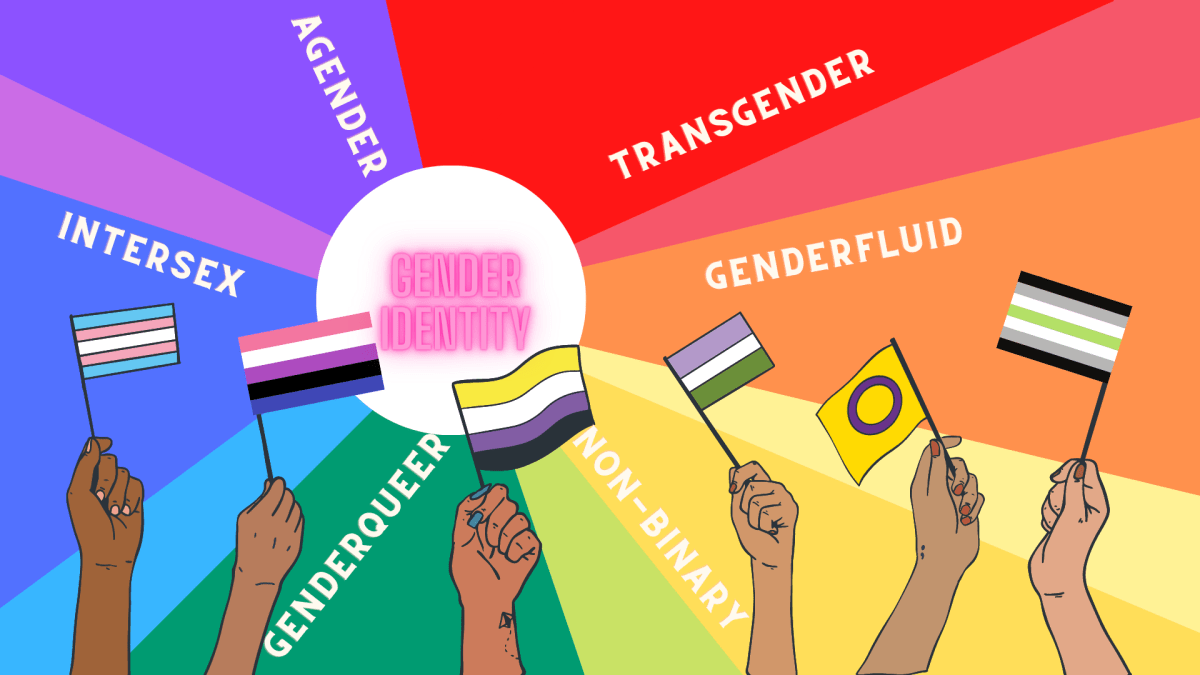
Most of the world exists in a gray area, and gender is no different. Gender is indeed a spectrum. But to explain this further, first we must define.
Gender anatomy and gender identity are different things. Gender anatomy refers to the sexual organs and genitals of a person, while gender identity is the gender one’s brain identifies as theirs. For a lot of people, these simply happen to match up, but for those who do not, life is automatically more difficult. Both gender identity and anatomy exist on a spectrum (that is, not entirely male or entirely female). Gender identity ranges from feminine to non-binary (neither male nor female) to masculine, with everything in-between. Gender anatomy exists on a spectrum, too: intersex individuals are those who are born with genitalia that is not obviously male or female, and it is estimated that around one in one-hundred babies are born intersex.
To begin, a human story: in August of 1965, two twin boys were born, but because of an accident during a procedure, one of the babies’ penises was cauterized (and burned off). The doctors suggested raising the baby as a girl, with accompanying medical procedures to remove the child’s testicles and administer female hormones during puberty. However, as she grew up, she “neither felt nor acted like a female.” She was miserable; she was not a girl. Her parents told her what happened at 14 years old, as she had become suicidal and depressed. She then began the transition back to a male, with a double mastectomy, testosterone injections, and two phalloplasty surgeries. He even married and adopted children — but what happened to him as a child was haunting, and created lasting effects. In 2004, David Reimer committed suicide.
Stories like this essentially disproved the notion that gender identity was a social construct: it could be changed by simply raising a child to fit gendered social norms, and if they weren’t treated as the other gender, they would adopt the one they were forced in. Gender identity, like gender anatomy, is determined by biology.
The process of developing sexual identity involves hormones, like that of genital development, but is a distinct process. For example, an increase in testosterone changes the structure and function of some parts of our brains. However, while sexual anatomy development happens roughly between 6-28 weeks, gender identity development occurs as the brain develops; that is, throughout our time in the womb. Sexual identity is complex, and difficult to study on non-humans, as researchers cannot ask a monkey its sexual identity. However, there is significant research that tells us that it does not always match genitalia.
Gender anatomy is not determined solely by whether one has one X chromosome or two. In fact, there are a myriad of factors that, if changed slightly, will result in a change of genitalia.
Sex chromosomes don’t always come in pairs of two. There can be an extra, and there can even be different arrangements in different tissues. But, chromosomes are only part of the picture. Any change in the hormone balance in the womb can change the sexual development of a fetus. For instance, the addition of testosterone pushes the fetus to form male genitalia, and too little either produces female genitalia or an intersex child. There are more than twenty-five genes that determine differences in sexual development (and fifty that determine sexual identity development).
Essentially, all gender is on a spectrum. The desire to establish a clear female or clear male from an intersex child, or a boy who feels entirely like a girl, is absolutely ludicrous. There is no normal or abnormal beyond social constructs. Why do we humans feel the need to force people into the categories of male and female, when some are naturally neither? Why, in a modern world, must an individual be forced into a role they feel sick playing? People today live as individuals before a pair, and we must treat them as such. Gender is scientifically a spectrum. Why would we treat it as anything else?
For Further Reading:
Becoming Nicole: The Story of an American Family, by Amy Ellis Nutt
Myths of Gender: Biological Theories About Women and Men, by Anne Fausto-Sterling
I am by no means an expert on this topic. For deeper education and an emotional understanding of the social difficulties those who do not fit “male” and “female,” these books are highly recommended. I reference Becoming Nicole quite a few times in this text.
We cannot prevent future horrors if we can’t all acknowledge the wrongdoing, nor can we simply “move on” from atrocities that continue to perpetuate inequality and trauma. A necessary step in acknowledging and making the future better than the past is formal recognition of the wrongdoing, because collective responsibility and remedial action is what makes the future brighter.
The U.S. government has apologized for six events in its almost two and a half centuries, which are as follows:
1- In 1983, the federal government apologized for hiding Nazi war criminal, Klaus Barbie, during World War II. The “butcher of Lyon” was sent to France earlier that year for trial.
2- In 1988, President Ronald Reagan apologized for Executive Order 9066, which sentenced most Japanese-Americans in the West to life in internment camps for most of WWII.
3- In 1993, the U.S. Congress apologized for its involvement in the overthrow of the Kingdom of Hawaii, which was orchestrated by American merchants and aided by the U.S. Marines.
4- In 1997, President Bill Clinton apologized for the Tuskegee Experiment. Starting in WWII, researchers in Alabama with the U.S. Public Health Service lied to black men who were expecting treatment for syphilis, instead giving them free meals and burials. Over 40 years, 399 men were untreated and unaware that they were subjects.
5- In 2008, the U.S. House of Representatives apologized for slavery and Jim Crow laws, symbolically acknowledging their active oppression of black Americans.
6- In 2009, the U.S. apologized for the treatment of Native Americans, in the “Defense Appropriations Act of 2010.” In Section 8113: “Apology to Native Peoples of the United States” on page 45 of 67, the U.S. “expresses its regret for the ramifications of former wrongs.”
The U.S. has irreparably damaged millions of lives and hundreds of communities in our 250 year-long history of colonizing and imperializing. As a nation, we continue to ignore and contest the long-term effects of systemic racism, sexism, ableism, and homophobia, which only serves to re-traumatize and stigmatize marginalized groups.
These apologies are a small, poor example of the relatively limited attempts of the U.S. as a whole to recognize, repair, and improve. Only three of these six apologies have come with monetary compensation or change, and six apologies in a 250-year history riddled with malfeasance is unacceptable. The first step to righting any wrong is acceptance. The U.S. must take responsibility for its wrongs before there can be any hope to repair them, because if the problems aren’t shown as problems, there will be no support. The children at the border in internment camps much like those of the Japanese decades earlier needs to stop. The Equal Rights Amendment must be passed, abortion rights expanded. The U.S. needs to apologize to Black Americans for all that they have been through and continue to go through, with fears of shooting, inequality, and hate. America is far from perfect, as any other nation on this Earth, but that’s no excuse to accept its flaws. We must move forward as a nation and acknowledge the pain we have inflicted on others. We need apologies, followed by active efforts for change. The end of internment camps at the border. The passing of the ERA. Increasing funding for social workers, public programs, and access to healthcare, housing, and employment to equal the footing of Black Americans. More apologies are only the beginning, but the U.S. must begin.
Sources:
Smithsonian Magazine Article on U.S. Apologies
Acknowledgement of U.S. Role in Hiding Klaus Barbie: Klaus Barbie and the U.S. Government: A Report to the Attorney General of the United States
Apology to Japanese Americans: Ronald Reagan’s “Remarks on Signing the Bill Providing Restitution for the Wartime Internment of Japanese American Civilians”
Apology to the Victims of the Tuskegee Experiment: Bill Clinton’s “Remarks by the President in Apology for Study Done in Tuskegee”
Apology to Native Hawaiians: Statute 107 (Public Law 103-150, Joint Resolution)
Apology to Black Americans: House Resolution 194 – Apologizing for the Enslavement and Racial Segregation of African Americans
Apology to Native Americans: Defense Appropriations Act of 2010
Further Reading:
United States Holocaust Memorial Museum Encyclopedia Article on Klaus Barbie
The Chandler Museum has archived their past exhibit, Gaman, on the Japanese internment camps in Arizona, linked here.
National Education Association Article on the Effects of the United State’s Occupation, Invasion, and Annexation of Hawaii
McGill Article on the Tuskegee Experiment
The Nation Article on The Federal Job Guarantee
ThoughtCo Article on Senate Apology to Native Americans
I’m Hannah Boese, a Master’s student at Arizona State University studying history. I focus on the history of the intersections between race, gender, sexuality, and other elements of identity that shape how we live. I believe in change and progress to promote equity and love, and hope to inspire them in all of you.
My goal is to engage with readers and promote awareness and involvement in civic duties and activism. History is a gift that must be analyzed and used to inform our actions as individuals and communities to ensure safer, happier, and freer lives for all.
 How Did We Get Here?