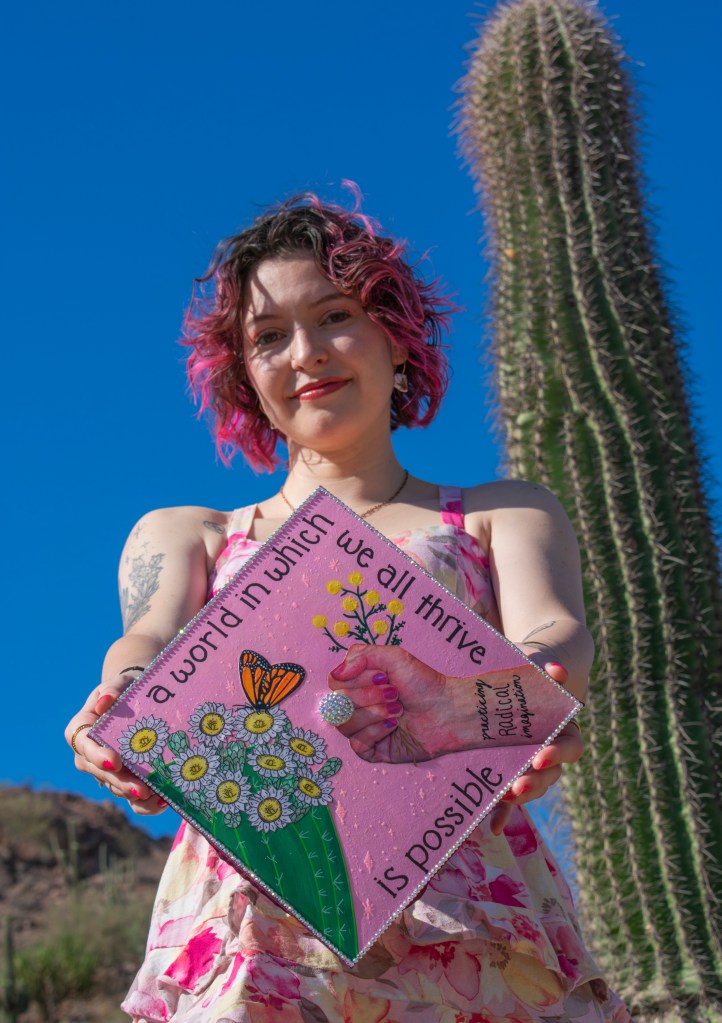
My M.A. graduation cap is a multimedia art project that my partner Cassie and I created to show not only what I learned in the program, but my aspirations moving forward.
The inspiration for my cap came largely from reading Andrea J. Ritchie’s book, Practicing New Worlds: Abolition and Emergent Strategies. In the following sections, key points from her book help explain the far-reaching goals of this art project.
Abolition
“Abolition” references the abolition of the Prison and Military Industrial Complexes. To be an abolitionist is to commit to “the practice of a world without surveillance, police, prisons, jails, or cages of any kind.” However, it is not so simple as “abolishing” these systems. It is about creating a world in which these systems “are no longer possible,” because the conditions, logics, and values “that produce and justify their existence no longer exist.” It requires that we create a world not only in which there are no prisons, but one in which they are unnecessary.
Emergent Strategies
Emergent strategies are, according to Ritchie and her colleague and author of Emergent Strategy adrienne maree brown, a “set of ideas about how to create, shift, and change complex systems – including human society – through relatively simple interactions.” These ideas include starting small, allowing for and learning from uncertainty, multiple perspectives and possibilities, experimentation, adaptation, iteration (or repeating processes), and decentralization.
When we, as people, focus on personal connections and relationships, building community, acting and reacting with intention, and cooperate with shared goals of sustainability, possibilities for change and action that we can take emerge. Allowing for such possibilities to emerge in these ways are emergent strategies.
Complexity Science
Complexity science refers to “scientific principles governing the operation of complex systems in nature and society” – in other words, how organisms act individually, repeated in groups, societies, and nations. For example, slime mold begins and lives as single cell organisms, acting independently when there is plentiful food. When food supply decreases, the individual cells coalesce, or combine, becoming a single organism that searches for food.
Together, abolitionist principles, emergent strategies, and complexity science show us how we can use small-scale change to enact the same radical change on larger scales. By learning from history and the natural world, we can use what we know to imagine, and create, new worlds.
These principles deny that we have to wait for something outside of us to prompt our action, for “it is in our power to shift the world within and around us.”
Imagining a New World in the Sonoran Desert
In this project, Cassie took and edited a picture of my hand, which is pulling up stinknet that I painted. If you come across stinknet, however, it is important to remove with gloves and a mask (see this link for more). In the place of the uprooted stinknet is a saguaro with blooms, and a monarch pollinating one of the blooms.
Stinknet is an invasive species in the Sonoran Desert that grow quickly and densely, displacing and crowding out native vegetation. Stinknet is also noxious, and can cause allergic reactions when it blooms, both to the skin and respiratory system. When they dry out, they are incredibly flammable, and the smoke is caustic, or destroys organic tissue.
The saguaro is a cactus only found in low elevations of the Sonoran desert, which covers most of southern Arizona, part of lower eastern California, and down through the Baja peninsula and western Sonora. These slow-growing, resilient giants are considered adults at 125 years, and are mostly water. Saguaros bloom through late April through early June, and flowers open at night and close the next afternoon. To become fruit, each flower must be pollinated within this short time period. To save water and reduce heat, they respirate at night, when temperatures drop below 90 degrees. The greatest threat to saguaros is climate change, particularly global warming, brought upon by human activity. In 2023 and 2024, saguaros in the Phoenix area in particular struggled with the record-breaking amount of days in which the lowest temperature was over 90 degrees. Without the nightly reprieve from heat, many saguaros were unable to respirate for days, and suffocated.
Monarch butterflies migrate each fall, and is one of the longest (known) insect migrations in the world. In both western and eastern North America, monarchs leave their cooler homes in the northern U.S. and Canada to their overwinter sites in the southern United States and Mexico. Monarchs can travel between 70 to 75 miles a day during their migration, and they pollinate essential plants along the way. The monarch butterfly, like the saguaro, is struggling to survive with human activity and climate change. The only plant that they can use to lay eggs on, milkweed, is decreasing with the use of pesticides in fields and commercialization of land. Unpredictable extreme temperatures are also affecting how and when monarchs migrate. In December 2024, The U.S. Fish and Wildlife Service proposed placing the Monarch under Endangered Species Act Protection, as their population has dwindled drastically.
While monarchs and saguaros, along with other native species, are struggling, stinknet has thrived off of human activity. It is our responsibility, as people, to work with organizations to serve the environment, and imagine a world in which nature thrives and it is not a privilege to engage with it.
This project is only the beginning of a series in which I invite you all to re-imagine the world around you.
Practicing Radical Imagination
A world in which we all thrive is possible – but it requires us filling the world with what we want. It requires that we “unlearn and unmake colonialism, racial capitalism, ableism, cisheteropatriarchy, and imperialism.” It requires a cultural intervention, so that our first responses are not punishment, but patience and reform. It requires that we imagine radically – or from the bottom, starting small, at the roots.
As author Walidah Imarisha asserted in “To Build a Future Without Police and Prisons, We Must Imagine it First,” “all real, substantive social change has been considered to be unrealistic at the time people fought for it.” Therefore, we need to imagine change that we are told is impossible. We need to ask, “what is the world we want?”
What if we all had what we needed – materially, physically, emotionally, socially? What if we all had nutrients? Access to comprehensive healthcare? Education? Fulfillment? What if we didn’t live in a global caqpitalist society that required the abuse of millions of people, species, and our Earth? What would that world look like?
These are the questions I hope to inspire with my cap and ongoing projects. I challenge you, as myself, to practice radical imagination, and remember that radical change is possible. Humans did not always live under these structures, and every step we have made to form the world we have today was thought to be impossible before it was done. The impossible is possible – we just have to imagine it and enact it.
Sources
Andrea J. Ritchie, Practicing New Worlds: Abolition and Emergent Strategies, Chico, CA: AK Press, 2023.
- Abolition: pages 45-54
- Complexity Science: 70-80
- Emergent Strategies: 7-8, 63-88
- Radical Imagination/Visionary Fiction: 48-49, 56-62
For further reading, see:
adrienne maree brown, Emergent Strategy: Shaping Change, Changing Worlds, Chico, CA: AK Press, 2017.
Mariame Kaba and Andrea J. Ritchie, No More Police: A Case for Abolition, New York: The New Press, 2022
Osha Davidson, “The slow death of a desert giant,” Yale Climate Connections, October 23, 2023.
Sonoran Desert Cooperative Weed Management Area, “Stinknet,” Arizona-Sonora Desert Museum.
Walidah Imarisha, “To Build a Future Without Police and Prisons, We Have to Imagine it First,” Medium, 2020.
Or listen to:
The Emergent Strategy Podcast, hosted by Sage crump, Mia Herndon and adrienne maree brown, a collaborative project of the Emergent Strategy Ideation Institute.

 How Did We Get Here?