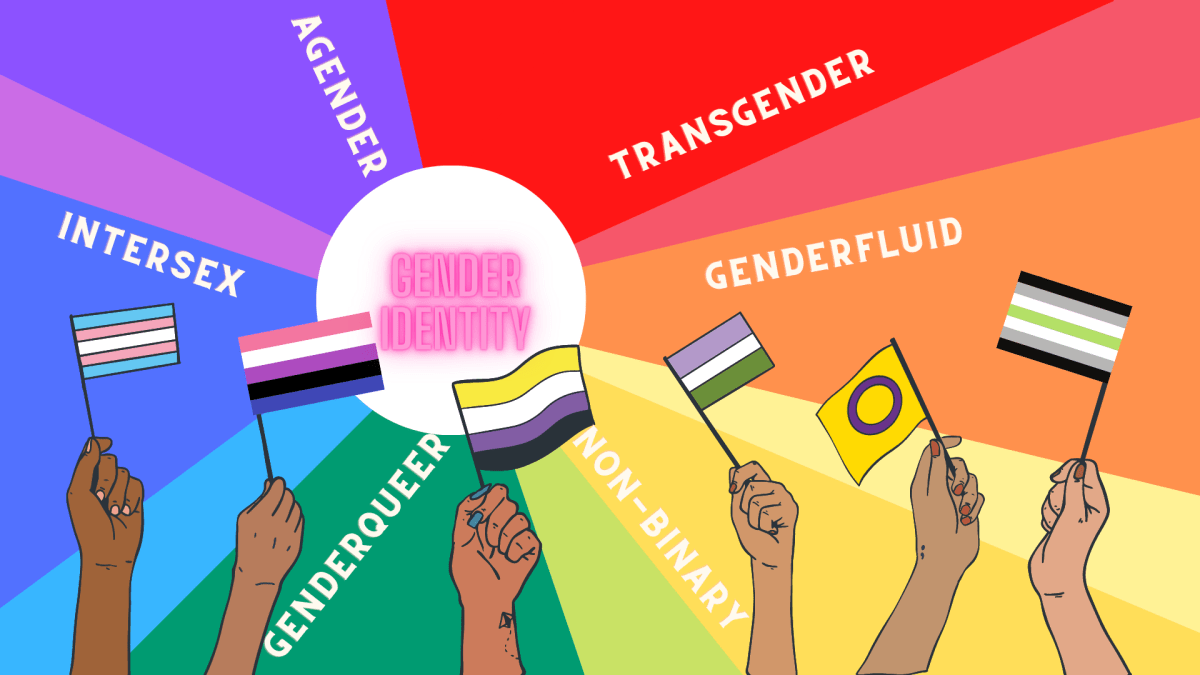
Most of the world exists in a gray area, and gender is no different. Gender is indeed a spectrum. But to explain this further, first we must define.
Gender anatomy and gender identity are different things. Gender anatomy refers to the sexual organs and genitals of a person, while gender identity is the gender one’s brain identifies as theirs. For a lot of people, these simply happen to match up, but for those who do not, life is automatically more difficult. Both gender identity and anatomy exist on a spectrum (that is, not entirely male or entirely female). Gender identity ranges from feminine to non-binary (neither male nor female) to masculine, with everything in-between. Gender anatomy exists on a spectrum, too: intersex individuals are those who are born with genitalia that is not obviously male or female, and it is estimated that around one in one-hundred babies are born intersex.
To begin, a human story: in August of 1965, two twin boys were born, but because of an accident during a procedure, one of the babies’ penises was cauterized (and burned off). The doctors suggested raising the baby as a girl, with accompanying medical procedures to remove the child’s testicles and administer female hormones during puberty. However, as she grew up, she “neither felt nor acted like a female.” She was miserable; she was not a girl. Her parents told her what happened at 14 years old, as she had become suicidal and depressed. She then began the transition back to a male, with a double mastectomy, testosterone injections, and two phalloplasty surgeries. He even married and adopted children — but what happened to him as a child was haunting, and created lasting effects. In 2004, David Reimer committed suicide.
Stories like this essentially disproved the notion that gender identity was a social construct: it could be changed by simply raising a child to fit gendered social norms, and if they weren’t treated as the other gender, they would adopt the one they were forced in. Gender identity, like gender anatomy, is determined by biology.
The process of developing sexual identity involves hormones, like that of genital development, but is a distinct process. For example, an increase in testosterone changes the structure and function of some parts of our brains. However, while sexual anatomy development happens roughly between 6-28 weeks, gender identity development occurs as the brain develops; that is, throughout our time in the womb. Sexual identity is complex, and difficult to study on non-humans, as researchers cannot ask a monkey its sexual identity. However, there is significant research that tells us that it does not always match genitalia.
Gender anatomy is not determined solely by whether one has one X chromosome or two. In fact, there are a myriad of factors that, if changed slightly, will result in a change of genitalia.
Sex chromosomes don’t always come in pairs of two. There can be an extra, and there can even be different arrangements in different tissues. But, chromosomes are only part of the picture. Any change in the hormone balance in the womb can change the sexual development of a fetus. For instance, the addition of testosterone pushes the fetus to form male genitalia, and too little either produces female genitalia or an intersex child. There are more than twenty-five genes that determine differences in sexual development (and fifty that determine sexual identity development).
Essentially, all gender is on a spectrum. The desire to establish a clear female or clear male from an intersex child, or a boy who feels entirely like a girl, is absolutely ludicrous. There is no normal or abnormal beyond social constructs. Why do we humans feel the need to force people into the categories of male and female, when some are naturally neither? Why, in a modern world, must an individual be forced into a role they feel sick playing? People today live as individuals before a pair, and we must treat them as such. Gender is scientifically a spectrum. Why would we treat it as anything else?
For Further Reading:
Becoming Nicole: The Story of an American Family, by Amy Ellis Nutt
Myths of Gender: Biological Theories About Women and Men, by Anne Fausto-Sterling
I am by no means an expert on this topic. For deeper education and an emotional understanding of the social difficulties those who do not fit “male” and “female,” these books are highly recommended. I reference Becoming Nicole quite a few times in this text.

 How Did We Get Here?